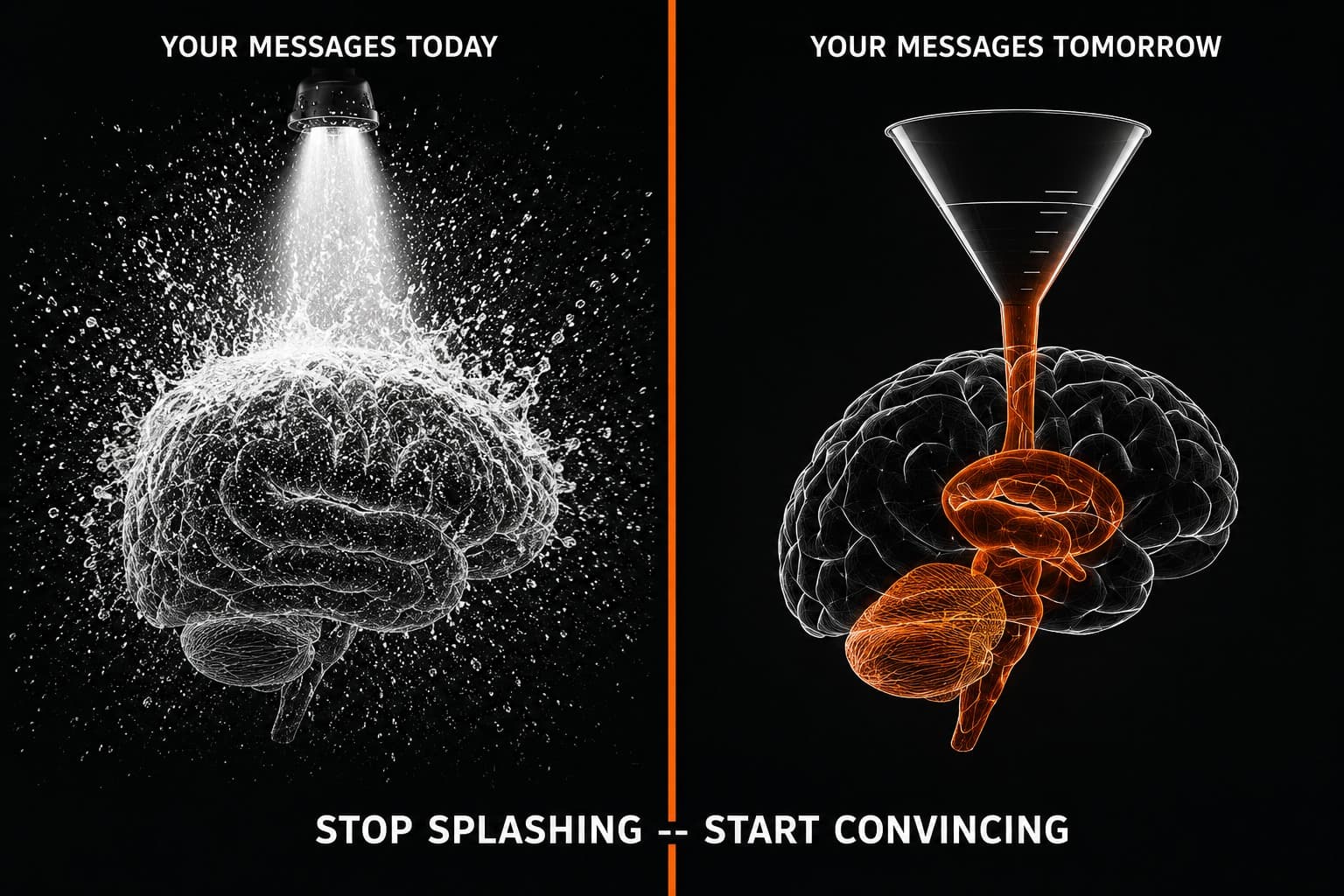
It’s all about brain science!
NeuroMap®
A brain-based model of persuasion, validated over two decades. Its practical use is ending the meeting where six people have opinions about the creative and nobody has evidence.
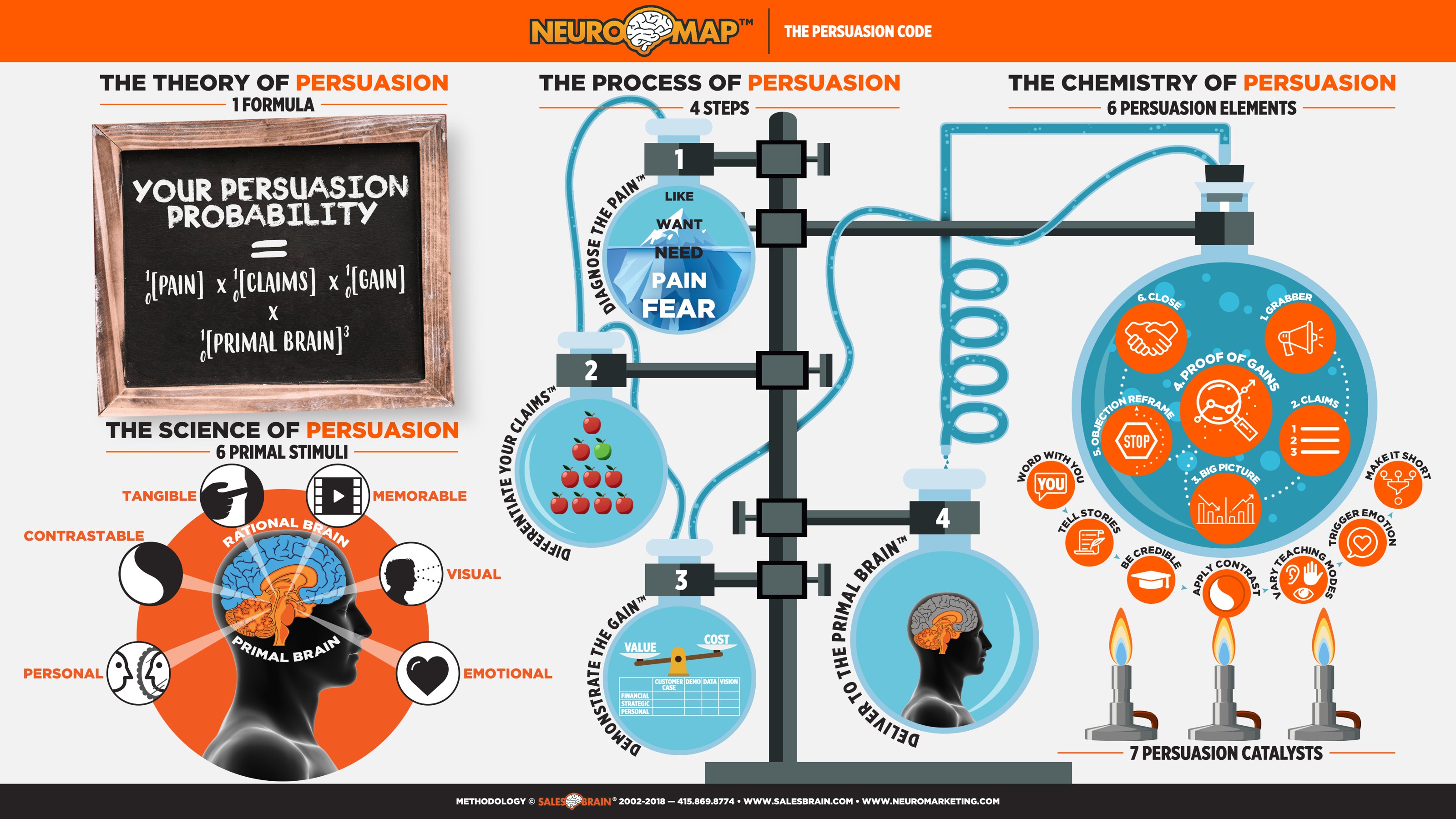
The whole model, one sheet
One formula. Six stimuli. Four steps.
Six elements. Seven catalysts.
NeuroMap® methodology · SalesBrain 2002–2026
How persuasion works
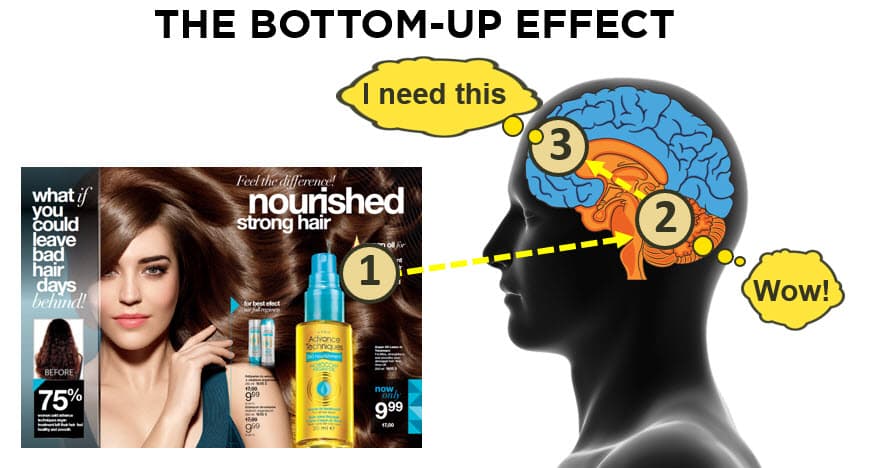
Persuasion is a bottom-up process.
Every message begins with a stimulus that first captures attention. The primal brain evaluates it before the rational brain ever engages.
Primal evaluation
A fast relevance and desire check: do I want it, does it matter to me?
Emotional signal
An instant liking or aversion forms — before a single word is processed.
Rational justification
The reasoning brain arrives last, and builds a case for what has already been decided.
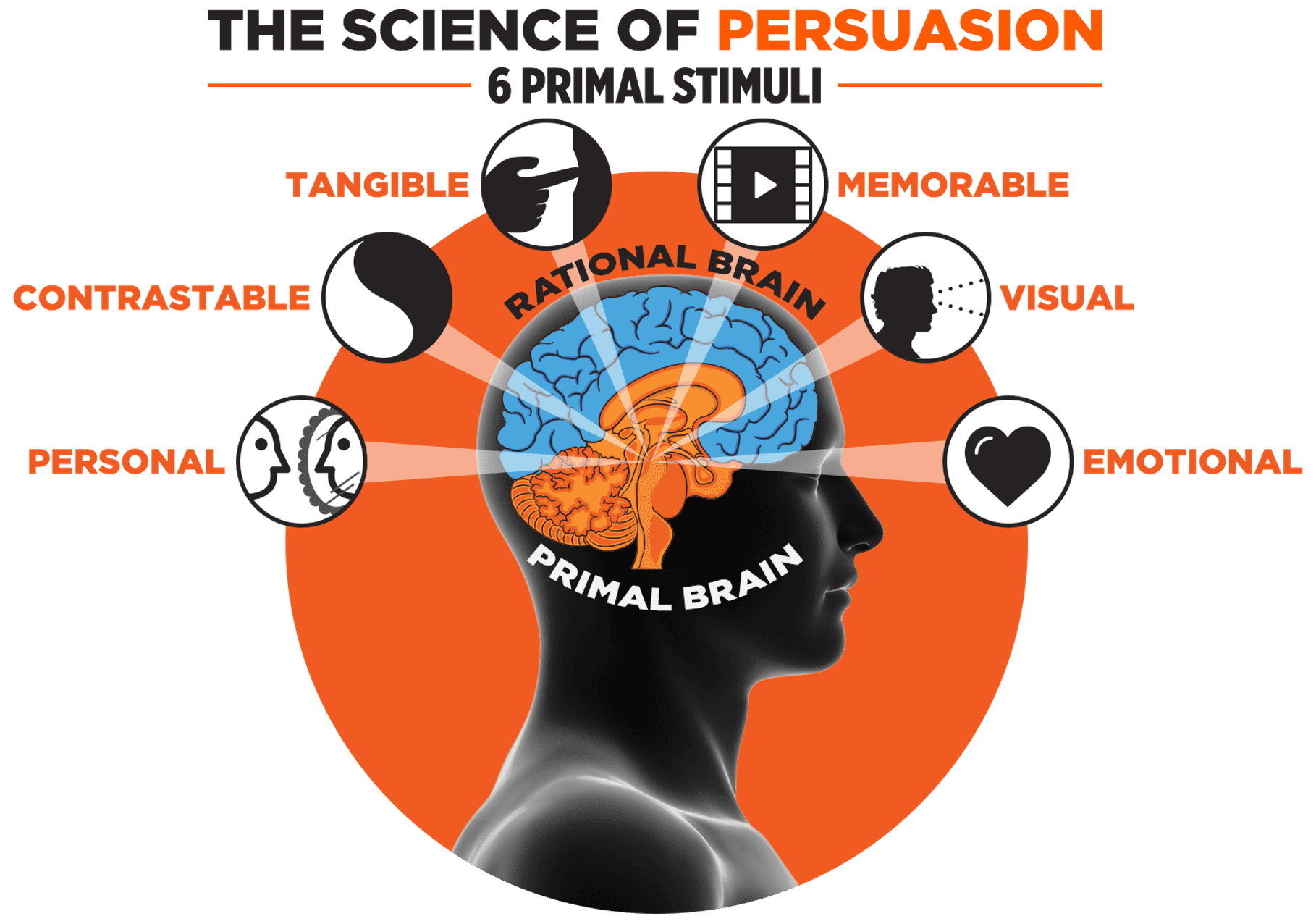
Six primal stimuli
Six hardwired biases. One score.
Every brain runs on the same six. NeuroMap® measures how well your message speaks to each, grades them A to C against recorded evidence, and weights them into a single number you can defend in a boardroom.
The science
The brain that decides
isn’t the one you’re talking to.






Stimulus 01 of 6
It’s about them.
The primal brain is the center of ME. It has no patience or empathy for anything that doesn’t immediately concern its own well-being, and it scans for threats before it attends to pleasure. A message that opens with your company has already lost.
Explore the full modelYour persuasion probability
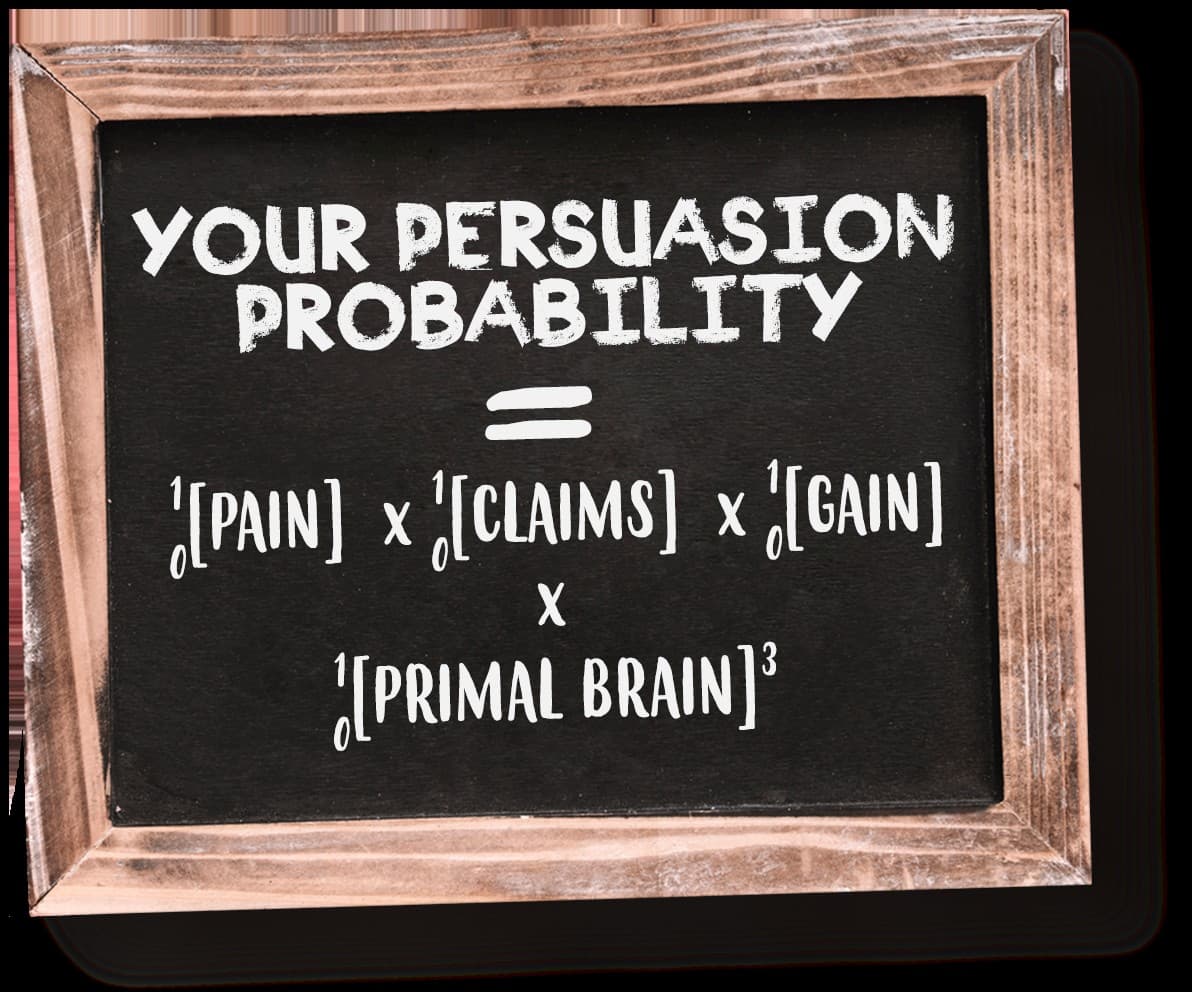
Your persuasion probability.
Each factor impacts your probability to persuade — weakness in any single factor sharply cuts overall success. A brilliant claim attached to an unfelt pain does not average out. It collapses.
- PAIN
- Frame the threat — personal and visceral.
- CLAIMS
- Contrastable — before/after, us/them.
- GAIN
- Tangible, concrete value. Never abstract.
- PRIMAL BRAIN³
- Raised to the third power. It dominates everything.
The process of persuasion
Four steps, in this order.
Reorder them and the message stops working. Most campaigns start at step three, demonstrating gain to someone who has not yet agreed there is a pain.
Diagnose the PAIN™
Like · Want · Need · Pain · Fear
Most briefs describe what the customer likes. Decisions are made much further down in their psyche — at the need, pain and fear level. The first job is finding which level you are actually selling to.
Differentiate your CLAIMS™
No more than three
A claim only exists if it is different from every other apple in the barrel. If a competitor could say the same sentence, it is not a claim — it is a description.
Demonstrate the GAIN™
Value against cost
Proof comes in four currencies — a customer case, a demo, data, or a vision — across three kinds of value: financial, strategic and personal. Abstract benefit is not gain.
Deliver to the PRIMAL BRAIN™
Where the decision is actually made
The first three steps can be right and still fail if the message is delivered to the rational brain. Delivery is not presentation polish — it is routing.
The chemistry of persuasion
Six elements every persuasive message should contain.
Grabber
Capture their attention in the opening seconds. Your value proposition communicated in seven seconds or less.
Claims
Three at most, repeated. More than three and none of them survive.
Big Picture
One visual that carries the whole argument without a caption.
Proof of Gains
Evidence in the currency your buyer actually counts in.
Objection Reframe
Objections are a manifestation of the fear of regret. Use emotion, not cognition, to counteract them.
Close
Don’t force the close. Let them commit to it.
Seven persuasion catalysts
Seven persuasion catalysts that make any of your six persuasion elements persuade harder.
Word with You
The most persuasive word in any language is the one that points at the listener.
Tell Stories
Narrative transportation is the softest yet most effective persuasion strategy.
Be Credible
Your charisma is perceived before your content. It cannot be faked in delivery.
Apply Contrast
Before and after, with and without. Contrast is what makes deciding cheap.
Vary Teaching Modes
Visual, auditory, kinesthetic. Attention decays on a single teaching channel — so vary it.
Trigger Emotion
No emotional spike, no chemical marker, no memory, no decision.
Make it Short
Every additional sentence is a further tax on a brain that is already leaving.
Find out where your message loses them.
A diagnosis takes weeks, not quarters, and tells you what to change first. Start with a conversation about what you’re selling and who keeps saying no.